Showing posts with label Great Quotes. Show all posts

Saturday, February 26, 2011

A Thank You to Rob Bell


This might sound weird, but I would like to publicly thank Rob Bell for his new book. The reason that I would like to thank him, is the same reason I express thanks to Brian Mclaren and Tony Jones. They have finally come out and exposed to the world their heretical views. They can no longer try to hide behind an Orthodox Christian veneer. They have, by their own words, firmly put themselves out of the camp of Christianity and their words have exposed them for the wolves in sheep's clothing that they have always been. For that I thank them for finally saying what they truly believe and exposing their teeth for all the sheep to see, so they might run to the shepherd for safety

Rob Bell has been one of the slipperiest and influential heretics in recent memory. He has the ear of countless youth groups and young believers. I myself was an avid viewer of his videos when I first came to faith. He is very friendly and engaging in his delivery, very entertaining in his productions and presentations, and like every bit of rat poison, he says some stuff that sounds almost true. But he has been able to hide behind the cloud of fog created by his words, and now he is laid open and exposed. For proof of his heretical views, all you have to do IS TO CLICK HERE.

To answer Rob Bell, I will simply quote the words from J.C. Ryle. Listen to Bishop Ryle's response to one who denies hell:

They are preaching up the devil's old, favorite doctrine!

There is such a place as Hell. Let no one deceive you with vain words. What people do not like--they try hard not to believe. When the Lord Jesus Christ comes to judge the world, He will punish all who are not His disciples with a fearful punishment!All who are found unrepentant and unbelieving; all who have clung to sin; all who have set their affections on worldly things; all who are without Christ--all such shall come to a dreadful end! "Anyone whose name was not found recorded in the Book of Life--was thrown into the Lake of Fire!" Revelation 20:15

1) I know that some people do not believe that there is any Hell at all. They think it impossible, that there can be such a place. They call it inconsistent with the mercy of God. They say that it is too awful an idea to be really true. The devil of course, rejoices in the views of such people. They help his kingdom mightily. They are preaching up the devil's old, favorite doctrine, "You shall not surely die!" Genesis 3:4

2) I know furthermore, that some do not believe that Hell is eternal! They tell us it is incredible, that a compassionate God will punish people forever. They imagine that He will surely open the prison doors of Hell at last. This also is a mighty help to the devil's cause.

3) I know also that some believe that there is a Hell--but never allow
that anybody is going there! They imagine that . . . all people are
good, all are sincere, all mean well, and all, they hope,
will go to Heaven when they die! Alas! what a common delusion is this!

If I never spoke of Hell--I would think I had kept back something that was profitable, and would look on myself as an accomplice of the devil. Reader, I beseech you, in all tender affection--beware of false views of the subject on which I have been dwelling. Beware of new and strange doctrines about Hell and the eternity of
punishment. Beware of manufacturing a god of your own:

a god who is all mercy--but not just;

a god who is all love--but not holy;

a god who has a Heaven for everybody--but a Hell for none;

a god who will make no distinction between godly and the ungodly in eternity.

Such a god is an idol of your own imagination! It is as truly an idol--as any snake or crocodile in an Egyptian temple! The hands of your own imagination and sentimentality have made it! It is not the God of the Bible--and beside the God of the Bible, there is no God at all.

Friday, June 4, 2010

The Lion Of Princeton Teaching On The Difference Between Justification and Santification


What an amazing and clarifying quote from B.B. Warfield. Very clear and very precisely worded. We are justified by Faith and Faith alone. Our sanctification comes from the justification won by Christ on the Cross. The Cross and Jesus justifying us causes us to be Sanctified. Beautiful! So much Confusion about this in the church.
Dear Christian, if you have faith in Christ, you are Justified before The Father, Because of what Christ has done, and the work on the cross. Christ is interceding for you at the Right Hand of The Father, and has blessed you with every spiritual blessing (Eph 1:3). The will of God is your Sanctification (1 Thes 4:3). You cannot be Justified without faith, and you cannot be sanctified without being Justified. The original Post may be found HERE.
"There is no evidence presented here that the New Testament represents
sanctification as received immediately by faith. In point of fact there is no
direct statement to that effect in the New Testament. It is to Jellinghaus’*
credit that he does not adduce for it either Acts xv.9 or xxvi.18, which are
often made to do duty in this sense. His strong conviction that sanctification
is obtained directly and immediately by faith is a product not of his Scriptural
studies, but of his “mediating theology.” According to that theology, when we
receive Christ by faith we receive in Him all that He is to us at once; all the
benefits which we receive in Him are conceived as received immediately and
directly by the faith through which we are united with Him and become sharers in
all that He is. Justification and sanctification, for example, are thought of as
parallel products of faith. This is not, however, the New Testament
representation. According to its teaching, sanctification is not related to
faith directly and immediately, so that in believing in Jesus we receive both
justification and sanctification as parallel products of our faith; or either
the one or the other, according as our faith is directed to the one or the
other. Sanctification is related directly not to faith but to justification; and
as faith is the instrumental cause of justification, so is justification the
instrumental cause of sanctification. The vinculum which binds justification and
sanctification together is not that they are both effects of faith – so that he
who believes must have both – because faith is the prius of both alike. Nor is
it even that both are obtained in Christ, so that he who has Christ, who is made
to us both righteousness and sanctification, must have both because Christ is
the common source of both. It is true that he who has faith has and must have
both; and it is true that he who has Christ has and must have both. But they do
not come out of faith or from Christ in the same way. Justification comes
through faith; sanctification through justification, and only mediately, through
justification, through faith. So that the order is invariable, faith,
justification, sanctification; not arbitrarily, but in the nature of the case.
(B. B. Warfield, “The German Higher Life Movement,” in Perfectionism, vol. 1,
pp. 362-363)

*Theodore Jellinghaus was a German Lutheran missionary to India, and later a Lutheran pastor in the vicinity of Potsdam.

Thursday, May 27, 2010

Enthralled With The Doll Or The Rattle


What a wonderful God Exulting Quote from Thomas Brooks! Christ is our treasure! To look to anything else than Christ will not satisfy. To not be satisfied in God and him only is an egregious evil! Scripture says the same in Jeremiah 2:12-13, a passage worth memorizing for all Christians. Exult in the Lord Your God with all your heart! find all your joy in HIM, not on his gifts. Worship and praise the giver, not the trinket.

Enthralled with the doll or the rattle
(Thomas Brooks, "A Word in Season to Suffering Saints")

"O God, you are my God, earnestly I seek You; my soul thirsts for You, my body longs for You, in a dry and weary land where there is no water. I have seen You in the sanctuary and beheld Your power and your glory. Because Your love is better than life, my lips will glorify You!" Psalm 63:1-3

Be sure that you don't take up your greatest delight . . .
in any creature,
in any comfort,
in any contentment,
in any worldly enjoyment.

When the mother sees that the child is enthralled with the doll or the rattle--she comes not in sight. If you take up your rest in any of the dolls and rattles--in any of the poor things of this world--God will certainly keep out of sight! He will never honor them
with His gracious presence--who enthralled with anything below Himself, below His presence.

When you begin to be tickled and enthralled with this and that worldly enjoyment, reason thus, "Here is a gracious spouse, here are precious children, here is a pleasant home, here is a wonderful climate, here is a gainful trade, etc. But what are all these to me--so long God has withdrawn His presence from me?"

Remember this once for all: that the whole world is but a barren wilderness--without the gracious presence of God!

Thursday, May 20, 2010

Great Quotes From A Smart Dead Guy


Here is a great quote from Samuel Davies

Your salvation makes amends for all His sufferings!
(Samuel Davies, "The Sufferings of Christ, and Their Consequent Joys and Blessings")

"He shall see His seed! He shall see of the travail of His soul, and shall be satisfied!" Isaiah 53:10-11

Jesus is now exalted to His throne in the highest heavens; and from thence He takes a wide survey of the universe. He looks down upon our world--and beholds kings in their grandeur, victorious generals with all their power, nobles and great men in all their pomp. But these are not the objects that best please His eyes. "He shall see His seed!" He sees one here, and another there, bought with His blood, and born of His Spirit; and this is the most delightful sight our world can afford Him. Some of them may be oppressed with poverty, covered with rags, or ghastly with famine; they may make no great figure in mortal eyes; but He loves to look at them! He esteems them as His children, and the fruits of His dying pangs!

The happiness of His exalted state consists, in a great degree--in the pleasure of seeing the designs of His death accomplished in the conversion and salvation of sinners!

His eyes are graciously fixed upon this assembly today! And if there is one of His spiritual seed among us--He can distinguish them in the crowd. He sees you drinking in His Words with eager ears! He sees you at His table commemorating His love! He sees your hearts breaking with penitential sorrows, and melting at His cross!

But these are not the only children whom He delights to view; they are not all in such an abject, imperfect state. No! He sees a glorious company of them around His throne in heaven, arrived to maturity, enjoying their inheritance, and resembling their divine Parent!

How does His benevolent heart rejoice to look over the immense plains of heaven--and see them all peopled with His seed! When He takes a view of this numerous offspring, sprung from His blood, and when He looks down to our world--and sees so many infants in grace, gradually advancing to their adult age; when He sees some, perhaps every hour since He died upon Calvary, entering the gates of heaven, having finished their course of education upon earth; I say, when this prospect appears to Him on every hand--how does He rejoice!

Now the prophecy in my text is fulfilled! "He shall see of the travail of His soul--and shall be satisfied!" If you put the sentiments of His benevolent heart into language, methinks He would say, "Since My death has been so fruitful of such a glorious posterity--I am well satisfied. I desire no other reward for all My agonies for them. If this end is but answered--I am fully satisfied by My hanging on the tree for them!"

Suppose that He should this day appear to you in that suffering form--sweating great drops of blood, accused, insulted, bruised, scourged, nailed upon the cross! And suppose He should turn to you with a countenance full of love and pity, and drenched with blood and tears, and address you in such moving language as this:"See! sinners--see what I suffer for you! See at what a dear rate I purchase your salvation! See how I love you! And now I have only this to ask of you in return: that you would forsake those murderous sins which thus torment Me; that you would love and serve Me; and receive that salvation which I am now purchasing with the blood of My heart! This I ask, with all the importunity--of My last breath, of My bleeding wounds, and My expiring groans. Grant Me but this--and I am well satisfied! I shall think of all My sufferings, as well bestowed."

O sirs, must not your heart melt away within you, to hear such language as this? See the strength of the love of Jesus! If you are but saved--He does not begrudge His blood and life for you! Your salvation makes amends for all His sufferings! This He accounts His greatest joy--a joy more than equivalent to all the pains He endured for you! He has full satisfaction for all the sorrows you have caused Him!

But alas! If you are not saved--then you will perish forever under the weight of His righteous vengeance--and He will rejoice over your damnation! He will glorify Himself in your destruction! The flames of hell will burn dreadfully bright--when He will please Himself in the execution of His justice upon you!Alas! Is the happiness of heaven--the only kind of happiness that you are careless about? Is the salvation of your immortal soul--the only deliverance for which you have no desire? Alas! Have you become so stupidly wicked!!

"He shall see His seed! He shall see of the travail of His soul, and shall be satisfied!" Isaiah 53:10-11

Tuesday, February 23, 2010

Adoniram Judson's letter to ask permission to Court Ann


On June 28, 1810 Judson and others presented themselves to the Congregationalists for missionary service in the East. He met Ann that same day and fell in love. After knowing Ann Hasseltine for one month he declared his intention to become a suitor, and wrote to her father the following letter:

I have now to ask, whether you can consent to part with your daughter early next spring, to see her no more in this world; whether you can consent to her departure, and her subjection to the hardships and sufferings of missionary life; whether you can consent to her exposure to the dangers of the ocean, to the fatal influence of the southern climate of India; to every kind of want and distress; to degradation, insult, persecution, and perhaps a violent death. Can you consent to all this, for the sake of him who left is heavenly home, and died for her and for you; for the sake of perishing, immortal souls; for the sake of Zion, and the glory of God? Can you consent to all this, in hope of soon meeting your daughter in the world of glory, with the crown of righteous, brightened with the acclamations of praise which shall redound to her Savior from heathens saved, through her means, from eternal woe and despair?

....That is a man who knew his calling, Loved his God, Loved the Lost, Loved a Woman, and Loved authority enough to ask, even such a hard thing and with such honesty as this...I want to be a man of God like this. I have no need to ask to court anyone, as I'm married to the greatest woman in the world, but I want to be a man of God like Adoniram!

Friday, October 23, 2009

Lamentations of a New-Born Soul

by John Newton

"Behold, I am vile!" Job 40:4

O Lord, how vile am I, Unholy and unclean!
How can I dare to venture nigh, With such a load of sin?

Is this polluted heart A dwelling fit for Thee?
Swarming, alas! in every part, What evils do I see!

If in Thy Word I look, Such darkness fills my mind;
I only read a sealed book, And no relief can find!

Thy gospel oft I hear, But hear it still in vain;
Without desire, or love, or fear, I like a stone remain!

Myself can hardly bear This wretched heart of mine!
How hateful, then, must it appear, To those pure eyes of Thine!

And must I, then, indeed,Sink in despair and die?
Fain would I hope that Thou didst bleed For such a wretch as I!

That blood which Thou hast spilt, That grace which is Thy own,
Can cleanse the vilest sinner's guilt, And soften hearts of stone!

Low at Thy feet I bow; O pity and forgive!
Here will I lie, and wait till Thou, Shalt bid me rise and live!

Thursday, October 1, 2009

How to Read a Book

Here is a great (and famous) quote from Mortimer Adler’s classic How To Read a Book.

*****

There are two ways in which one can own a book. The first is the property right you establish by paying for it, just as you pay for clothes and furniture. But this act of purchase is only the prelude to possession. Full ownership comes only when you have made it a part of yourself, and the best way to make yourself a part of it is by writing in it. An illustration may make the point clear. You buy a beefsteak and transfer it from the butcher’s icebox to your own. But you do not own the beefsteak in the most important sense until you consume it and get it into your bloodstream. I am arguing that books, too, must be absorbed in your blood stream to do you any good.

Confusion about what it means to “own” a book leads people to a false reverence for paper, binding, and type — a respect for the physical thing — the craft of the printer rather than the genius of the author. They forget that it is possible for a man to acquire the idea, to possess the beauty, which a great book contains, without staking his claim by pasting his bookplate inside the cover. Having a fine library doesn’t prove that its owner has a mind enriched by books; it proves nothing more than that he, his father, or his wife, was rich enough to buy them.

There are three kinds of book owners. The first has all the standard sets and best sellers — unread, untouched. (This deluded individual owns woodpulp and ink, not books.) The second has a great many books — a few of them read through, most of them dipped into, but all of them as clean and shiny as the day they were bought. (This person would probably like to make books his own, but is restrained by a false respect for their physical appearance.) The third has a few books or many — every one of them dog-eared and dilapidated, shaken and loosened by continual use, marked and scribbled in from front to back. (This man owns books.) …

But the soul of a book “can” be separate from its body. A book is more like the score of a piece of music than it is like a painting. No great musician confuses a symphony with the printed sheets of music. Arturo Toscanini reveres Brahms, but Toscanini’s score of the G minor Symphony is so thoroughly marked up that no one but the maestro himself can read it. The reason why a great conductor makes notations on his musical scores — marks them up again and again each time he returns to study them—is the reason why you should mark your books. If your respect for magnificent binding or typography gets in the way, buy yourself a cheap edition and pay your respects to the author.

Friday, September 25, 2009

Great Lessons from John Newton

I have been listening to sermons that John Piper has delivered over the years on Biographies of Famous men on the faith. They have been blessing me greatly. I listen to the stories of these men's lives and the lessons we can learn from their strengths and weaknesses. Their triumphs and their failures, and i want to be like these men. Listen to these men's lives as piper tells it and let your heart grow and let you soul pray out to God to make you like these men. I pray that, I want to be like these men. I so desperately want God to help me become like Jesus; To have his strength and his tenderness. Here is one great example, A quote from a sermon piper gave on the life of John Newton:

Ever since I came to Bethlehem in 1980 this vision of ministry
has beckoned me because, soon after I came, I read through Matthew and Mark
and put in the margin of my Greek New Testament a "to" (for tough) and a
"te" (for tender) beside all of Jesus' words and deeds that fit one category
or the other. What a mixture he was! No one ever spoke like this man.
It seems to me that we are always falling off the horse on one side or the
other in this matter of being tough and tender—wimping out on truth when we
ought to be lion-hearted, or wrangling with anger when we ought to be
weeping. I know it's a risk to take up this topic and John Newton in a
setting like this, where some of you need a good (tender!) kick in the
pants to be more courageous, and others of you confuse courage with what
William Cowper called "a furious and abusive zeal."[2] Oh how
rare are the pastors who speak with a tender heart and have a theological
backbone of steel.

I dream of such pastors. I would like to be one someday. A pastor whose might
in the truth is matched by his meekness. Whose theological acumen is matched
by his manifest contrition. Whose heights of intellect are
matched by his depths of humility. Yes, and the other way
around! A pastor whose relational warmth is matched by his rigor of study,
whose bent toward mercy is matched by the vigilance of his biblical
discernment, and whose sense of humor is exceeded by the seriousness of his calling. I dream of great defenders of true doctrine who are mainly known
for the delight they have in God and the
joy in God that they bring to the people of God—who enter
controversy, when necessary, not because they love ideas and arguments, but
because they love Christ and the church.

There's a picture of this in Acts 15. Have you ever noticed
the amazing unity of things here that we tend to tear apart? A false doctrine
arises in Antioch: some begin to teach, "Unless you are circumcised . . . you
cannot be saved" (v. 1). Paul and Barnabas weigh in with what Luke calls a
"not a little dissension and debate" 2). So the church decides to send them off
to Jerusalem to get the matter settled. And amazingly, verse 3 says that on
their way to the great debate they were "describing in detail the conversion
of the Gentiles, and were bringing great joy to all the brethren" (v. 3).
This is my vision: The great debaters on their way to a life-and-death show down of doctrinal controversy, so thrilled by the mercy and power of God in the gospel, that they are spreading joy everywhere they go. Oh how many there are today who tell us that controversy only kills joy and ruins the church; and oh how many others there are who, on their way to the controversy, feel no joy and spread no joy in the preciousness of Christ and his salvation.


One of the aims of this conference since 1988 has
been to say over and over again: it is possible and necessary to be as strong and
rugged for truth as a redwood and as tender and fragrant for Christ as a
field of clover.So now, with the help of the life of John Newton, I want
to say it again. And make no mistake: our heroes have feet of clay. There
are no perfect pastors. Newton himself warns us:
"In my imagination, I sometimes fancy I could
[create] a perfect minister. I take the eloquence of –, the knowledge of –, the
zeal of –, and the pastoral meekness, tenderness,
and piety of –: Then, putting them all together into one man, I say to
myself, "This would be a perfect minister." Now there is One, who, if he
chose to, could actually do this; but he never did it. He has seen fit to do
otherwise, and to divide these gifts to every man severally as he
will.
[3]So neither we nor Newton will ever be all
that we should be. But oh how much more like the Great Shepherd we should
long to be. Newton had his strengths, and I want us to learn from them. At
times his strengths were his weakness, but that too will be instructive


Thursday, September 24, 2009

A Great Quote from "Gospel Centered Hermeneutics" by Graeme Goldsworthy

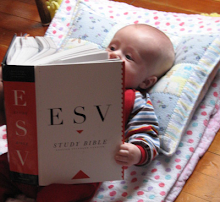
I am reading a great book Called "Gospel Centered hermeneutics" by Graeme Goldsworthy. You can purchase this book by Clicking hereI would really recommend this book to you. It is a very well done presentation of the state of Hermeneutics today and how we got to where we are. Also, what we can do to right the ship in the Church. I thought i would share this quote. It is fantastic.
Because of the interaction of God's grace and human sinfulness, the word that accompanies the event, and the event that is interpreted by the word, must be more than mere information giving. It must be a redemptive word-event that has the power to break through our self-imposed, sinful darkness. It is not the story as story that does this. Redemption is in the event by which God reconstructs an acceptable human history while judging the unacceptable. The doctrine of justification by faith involves the substitution of God's righteous history in Christ for our fallen and condemned histories or rebellion...The gospel reminds us that God will judge history by the man he has appointed, in demonstration of which he has raised him from the dead (Acts 17:31)/ the corollary of the gospel-based eschaton is that all people should repent of their own part in the dysfunctional nature of human history (Acts 17:30). god has put our rebellious history to death in the death of Christ. In the resurrection of Jesus he has brought the eschaton into our history. The resurrected Jesus is the new man of the new age. That single past event guarantees that, through our faith union with Christ, our past and our present will find consummation in the future.

Sunday, September 13, 2009

Lets get out there and be a nuisance to the world I love Spurgeon

This would be from PyroManiacs and team pyro. Phil Johnson and his crew run that. If you are not aquainted with this blog you should be. here is the link to them http://teampyro.blogspot.com/

Please read and enjoy and then get out there and witness, or teach, or preach. Please just go out and do something.

12 September 2009

Christian, Be a Nuisance to the World
Your weekly dose of Spurgeon
posted by Phil Johnson

The PyroManiacs devote some space each weekend to highlights from The Spurgeon Archive. The following excerpt is from "The Incomparable Bridegroom and His Bride," a sermon preached on Sunday evening, 10 June 1866, at the Met Tab.

Christians, be troublesome to the world! O house of Israel, be like a burdensome stone to the world! You are not sent here to be recognized as honorable citizens of this world, to be petted and well-treated.

Even Christ himself, the peaceable One, said, "I am come to send fire on the earth; and what will I, if it be already kindled?"

What I mean is this, we are not to be quiet about our religion. The world says to us, "Hold your tongue about religion, or at least talk about it at fit times; but do not introduce it at all seasons so as to become a pest and a nuisance."

I say again, and you know in what sense I mean it, be a nuisance to the world; be such a man that worldlings will be compelled to feel that there is a Christian in their midst.

An officer was walking out of the royal presence on one occasion, when he tripped over his sword. The king said to him, "Your sword is rather a nuisance." "Yes," was the officer's reply, "your majesty's enemies have often said so."

May you be a nuisance to the world in that sense, troublesome to the enemies of the King of kings! While your conduct should be courteous, and everything that could be desired as between man and man, yet let your testimony for Christ be given without any flinching and without any mincing of the matter.